
Prevalence of leptospirosis in Brazil from 2012 to 2022 and its relationship with basic sanitation
Prevalência de leptospirose entre 2012 e 2022 no Brasil e a relação com o saneamento básico
Isis Mello Mariano1, Líllian Oliveira Pereira da Silva2
1 Fundação Técnico-Educacional Souza Marques, In Memorian. Pós-graduação em Análises Clínicas. Rio de Janeiro, RJ, Brazil.
2 Escola Nacional de Saúde Pública Sérgio Arouca, Doutorado acadêmico em Saúde Pública e Meio Ambiente. Rio de Janeiro, RJ, Brazil.
Received on 08/07/2025
Approved on 11/12/2025
DOI: 10.21877/2448-3877.202600257.en
INTRODUCTION
According to the World Health Organization (WHO), approximately 4 billion people worldwide lack access to safely managed sanitation, and more than half of the global population lacks basic sanitation services.(1) In Brazil, only 55.8% of the population has access to sewerage services. Of the sewage generated, only 51.2% undergoes adequate treatment.(2) Consequently, although Brazil has the world’s largest freshwater reserves, most of its rivers are contaminated. Furthermore, a substantial proportion of the sewage generated in the country is improperly discharged into the environment, potentially causing immeasurable harm to water quality and ecosystems.(3)
Several diseases are waterborne, including typhoid fever, cholera, salmonellosis, shigellosis, and other forms of gastroenteritis that may be caused by bacteria or parasites. Approximately 80% of the diseases affecting the country are transmitted through water and are directly associated with high mortality rates among immunocompromised individuals.(1,4) Therefore, one of the primary concerns associated with the lack of sewage treatment and its improper disposal is the presence of potentially pathogenic microorganisms in the waters of rivers surrounding local communities, which may cause serious harm to human health.(5) It is important to emphasize that people in Brazil use aquatic environments for a variety of activities, which may result in continued exposure and, consequently, an increased risk of infection.(3,5)
Inadequate basic sanitation systems also facilitate the transmission of diseases such as leptospirosis. Leptospirosis, popularly known as “rat disease,” is caused by Leptospira interrogans and is transmitted primarily through direct or indirect contact with rodent urine; it is therefore closely associated with flooding.(6) The main reservoirs include rodents of the species Rattus rattus (roof rat or black rat), Mus musculus (house mouse), and particularly Rattus norvegicus (brown rat or sewer rat).(7) In addition to rodents, other animal species have also been reported as reservoirs, including pigs, cattle, horses, sheep, goats, and dogs.(8) Diagnosis, in turn, requires a more thorough investigation involving immunodiagnostic techniques selected according to the clinical stage of the disease and the patient’s condition, together with the assessment of clinical, epidemiological, and laboratory characteristics.(7)
Moreover, leptospirosis is a notifiable disease in Brazil and is of considerable social and economic relevance because of its association with poverty and neglected populations in the country.(9) Accordingly, this study aimed to discuss the prevalence of leptospirosis in Brazil between 2012 and 2022 and to highlight the importance of basic sanitation for disease control and prevention.
METHODS
Data on leptospirosis cases and deaths were obtained from the Notifiable Diseases Information System (SINAN),(10) whereas population data were obtained using the “Population Estimates from 1992 to 2021 Used by the Federal Court of Accounts (TCU)” filter and, for 2022, the Demographic Census conducted by the Brazilian Institute of Geography and Statistics (IBGE).
Annual data on financial investment in sanitation infrastructure were obtained from the National Sanitation Information System (SNIS),(2) available at https://www.gov.br/mdr/pt-br/assuntos/saneamento/snis/. This system compiles information and indicators on the provision of water supply, sewerage, solid waste management, and stormwater management services reported by service providers operating in Brazil.
Data analysis
The regions were compared using the prevalence rate (P) for each region, calculated as follows:

Mortality (M) was calculated as follows:

The total numbers of confirmed cases and deaths, together with resident population data, were compiled for Brazil and stratified by the country’s five geographic regions for the period from 2012 to 2022. The data were subsequently organized in a Microsoft Excel® spreadsheet.
RESULTS AND DISCUSSION
Leptospirosis is an acute infectious disease closely associated with inadequate basic sanitation, since transmission occurs through contact with sewage-contaminated water or mud, or with contaminated water from ponds and rivers. For the 2012–2022 study period, Figure 1 shows the annual number of confirmed leptospirosis cases by region of Brazil. Brazil recorded approximately 3,000 cases per year on average, with the highest number reported in 2014. This finding may be associated with the heavy rainfall and flooding reported throughout the country, with the North Region being the most severely affected.(11,12)
The highest numbers of cases in the South and Central-West Regions were recorded in 2015, at 1,588 and 80 cases, respectively. The climatic conditions of the Central-West Region are known to be unfavorable to the spread of leptospirosis. In addition, the low case count may reflect underreporting or the region’s low population density.(13)
In contrast, the predominance of leptospirosis in the South Region may be associated with the regional climate, the presence of rodents, exposure to livestock and agricultural activities, contact with rivers and/or streams, and grain storage.(14) In turn, the peak in the number of cases in northeastern Brazil occurred in 2022, which may be explained by the heavy rainfall that affected the region. This event was considered the greatest natural disaster of the century in the state of Pernambuco and may indicate an upward trend in leptospirosis cases in the coming years.(15–17)
Overall, 35,889 cases of leptospirosis were reported in Brazil between 2012 and 2022, with the South and Southeast regions accounting for the largest numbers, totaling more than 11,200 cases in each region. Although leptospirosis remains a neglected public health problem, it exhibits a seasonal pattern associated with rainy periods and affects different segments of the population, as shown in Figure 2.
Analysis of the annual leptospirosis prevalence rates showed that the South Region had the highest rate, at approximately 3.5 cases per 100,000 inhabitants (Figure 3). This finding is related not only to the region’s characteristic subtropical climate but also to the intensive agricultural activity carried out there.(18) According to Teles and colleagues (2023), the incidence of the disease in southern Brazil is twice as high in rural areas as in urban areas. This may be explained not only by difficulties in ensuring the use of personal protective equipment among rural workers but also by the greater abundance of rodents in rural areas, attracted by stored food.(18–20)
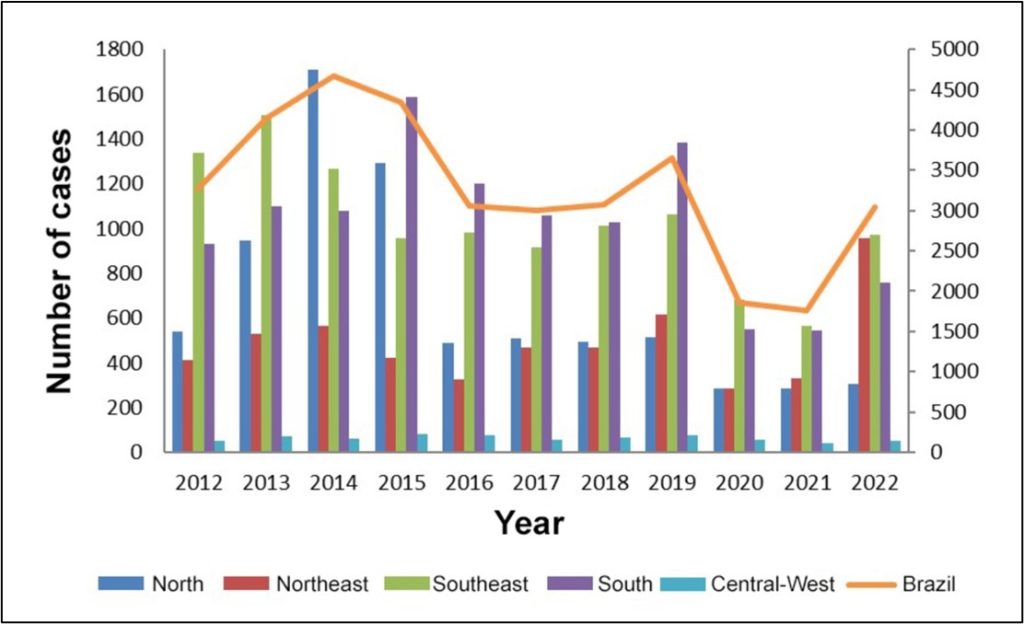
Figure 1
Number of leptospirosis cases in Brazil from 2012 to 2022.
Source: SINAN (2024).
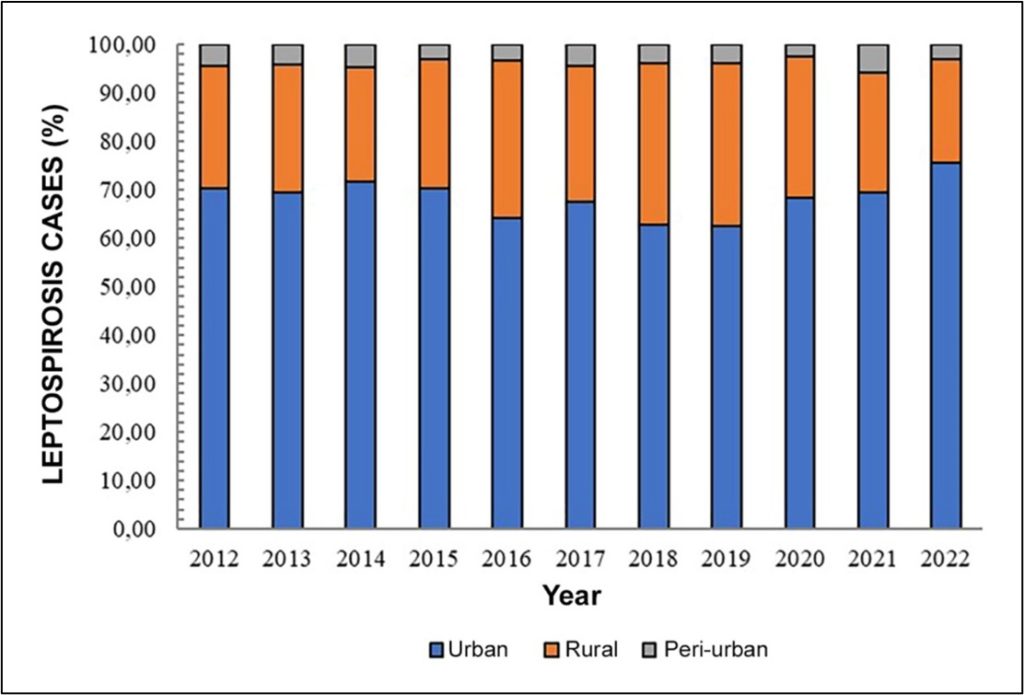
Figure 2
Distribution of leptospirosis cases by area of infection in Brazil from 2012 to 2022.
Source: SINAN (2024).
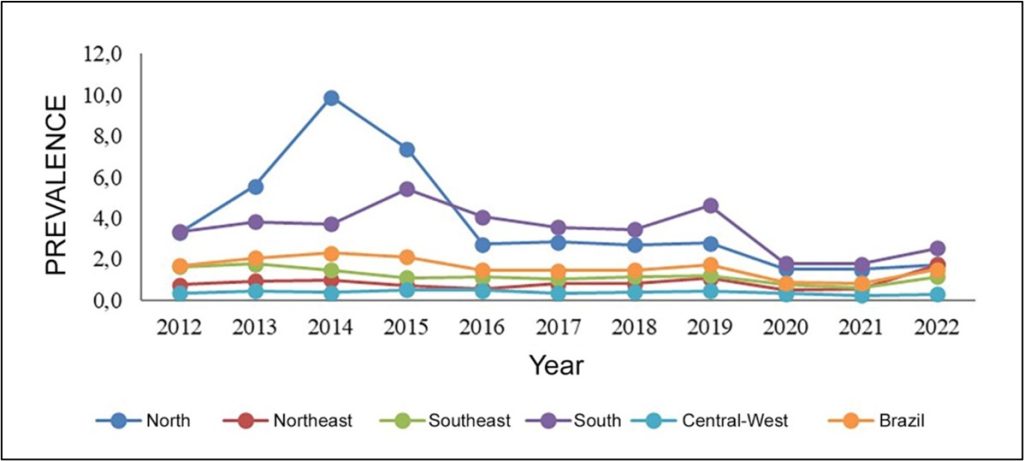
Figure 3
Prevalence of leptospirosis in Brazil from 2012 to 2022.
Source: SINAN (2024).
Prevalence in the Northeast, Southeast, and Central-West Regions remained below the national rate of 1.6 cases per 100,000 inhabitants through 2022. This finding is consistent with the study conducted by Marteli and colleagues in 2020, which analyzed the spatial and temporal distribution of leptospirosis in Brazil between 2007 and 2017.(13) Leptospirosis is therefore a neglected tropical disease that predominantly affects low-income populations living under precarious environmental, sanitary, socioeconomic, and infrastructural conditions.(21) In this context, leptospirosis prevalence gradually decreases as basic sanitation coverage expands across all regions of the country, demonstrating that investment in this sector is crucial for disease control.(21)
According to the study conducted by Diniz and colleagues (2025), deficiencies in sanitation infrastructure contribute to an increase in the number of cases.(22) Other associated factors have been reported in the literature, including proximity to rodents in urban areas, extreme weather events, and uncontrolled urbanization.(23) In 2021, Pintanel, Cecconello, and Centeno evaluated the correlation between basic sanitation indicators and the prevalence of waterborne diseases in municipalities in the state of Rio Grande do Sul.(24) In that study, the authors reported that leptospirosis was directly associated with inadequate basic sanitation and sewerage services, as well as with water contamination (p = 0.005).(24)
Therefore, greater investment is needed in leptospirosis prevention measures, including drainage systems; water collection and supply networks; infrastructure for the collection and treatment of solid waste and sewage; stormwater management; stream dredging, cleaning, and channelization; rodent control; housing improvements; and educational campaigns.(25) Finally, despite the limitations associated with the use of secondary data, particularly the underreporting that prevents an accurate representation of the country’s epidemiological situation, the present study highlights the need for new tools for leptospirosis surveillance and monitoring in Brazil, thereby supporting the development and implementation of public health policies.
FINAL CONSIDERATIONS
Leptospirosis transmission is directly associated with inadequate or absent basic sanitation, meaning that investment in sanitation has a direct impact on leptospirosis rates. In addition, leptospirosis exhibits a seasonal pattern associated with rainfall and flooding throughout the country, affecting different segments of the population. Leptospirosis is a notifiable disease in Brazil, and 35,889 cases were reported nationwide between 2012 and 2022, corresponding to approximately 3,000 cases per year. It should be noted that the climatic conditions of the Central-West Region are not favorable to the spread of leptospirosis and that the region has a low population density, which may explain the low leptospirosis rates observed in this region. In contrast, the predominance of leptospirosis in the South Region may be associated with the regional climate, the presence of rodents, exposure related to livestock farming and agriculture, contact with rivers and/or streams, and grain storage.
Despite the limitations related to the underreporting of leptospirosis cases and deaths, the present study highlights the need for new tools for disease surveillance and monitoring in Brazil to support the development and implementation of public health policies. It also underscores the need for investment in leptospirosis prevention measures, including adequate basic sanitation, housing improvements, and educational campaigns.
REFERENCES
- WHO; UNICEF. Progress on Drinking Water, Sanitation and Hygiene: 2017 update and SDG assessment. Genebra: World Health Organization. 66p, 2017.
- SNIS. Sistema Nacional de Informações sobre Saneamento. 2024. Available from: https://www.gov.br/mdr/pt-br/assuntos/saneamento/snis/ Accessed on Sep 26, 2024.
- Godefroid RS, et al. Análise microbiológica da água do Rio Bacacheri, em Curitiba (PR). Eng Sanit Ambient, v. 23, n. 5, p. 993-998, 2017.
- Porto MAL, et al. Coliformes em água de abastecimento de lojas fast-food da Região Metropolitana de Recife (PE, Brasil). Ciência & Saúde Coletiva, v. 16, n. 1, p. 2653-2658, ago./2008.
- Ferreira FDS, et al. À margem do rio e da sociedade: a qualidade da água em uma comunidade quilombola no estado de Mato Grosso. Saúde Soc, v. 26, n. 3, p. 822-828, 2017.
- Fiocruz Rondônia. Fiocruz RO orienta sobre riscos de transmissão da Leptospirose. 2019. Available from: https://www.rondonia.fiocruz.br/fiocruz-ro-orienta-sobre-riscos-de-transmissao-da-leptospirose/ Accessed on: Jul 29, 2025.
- Oliveira SV, Arsky MLNS, Caldas EP. Reservatórios animais da leptospirose: Uma revisão bibliográfica. Saúde (Santa Maria), p. 9-20, 2013.
- Brasil. Ministério da Saúde. Leptospirose: diagnóstico e manejo clínico. Departamento de Vigilância das Doenças Transmissíveis. – Brasília: Ministério da Saúde, 46p. 2014.
- Souza W. Doenças negligenciadas. Academia Brasileira de Ciências, Rio de Janeiro, 43p, 2010.
- SINAN. Doenças e Agravos de Notificação – 2007 em diante. 2024. Available from: https://datasus.saude.gov.br/acesso-a-informacao/doencas-e-agravos-de-notificacao-de-2007-em-diante-sinan/. Accessed on Sep 26, 2024.
- El País. Brasil e Bolívia disputam a culpa pelas inundações na região Norte. 2014. Available from: https://brasil.elpais.com/brasil/2014/03/12/politica/1394656196_320544.html. Accessed on Jul 28, 2025.
- ONU. ONU afirma que 2014 foi marcado por calor extremo e enchentes. 2015. Available from: https://news.un.org/pt/story/2015/03/1505941. Accessed on Sep 28, 2024.
- Marteli NA, et al. Análise espacial da leptospirose no Brasil. Saúde em Debate, v. 44, p. 805-817, 2020.
- Gaklik KC, Berlezi EM. Incidência de leptospirose nas regiões brasileiras entre os anos de 2015 a 2019: um alerta para a região sul. Salão do Conhecimento, v. 7, n. 7, 2021.
- Folha de Pernambuco. Maior tragédia do século em Pernambuco, mortes pelas chuvas de 2022 superam total da cheia de 1975. 2022. Available from: https://www.folhape.com.br/noticias/maior-tragedia-do-seculo-em-pernambuco-mortes-pelas-chuvas-de-2022/228963/. Accessed on Jul 28, 2025.
- MetSul. Chuva extrema no Nordeste do Brasil neste fim de semana. 2022. Available from: https://metsul.com/chuva-extrema-no-nordeste-do-brasil-neste-fim-de-semana/. Accessed on Sep 28, 2024.
- G1. Pesquisadores investigam causas da tragédia que deixou 133 mortos após fortes chuvas em 2022 no Grande Recife. 2023. Available from: https://g1.globo.com/pe/pernambuco/noticia/2023/06/01/pesquisadores-investigam-causas-da-tragedia-que-deixou-133-mortos-apos-fortes-chuvas-em-2022-no-grande-recife.ghtml. Accessed on Jul 28, 2025.
- Frederico GM, et al. Análise Epidemiológica da Mortalidade Ocasionada pela Leptospirose na Região Sul do Brasil no Período 2017-2022. Revista Pleiade, v. 18, n. 45, p. 96-106, 2024.
- Teles AJ, Bohm BC, Silva SCM, et al. Fatores sociogeográficos e vulnerabilidade à leptospirose no Sul do Brasil. BMC Saúde Pública, v. 23, p. 1311, 2023.
- Perez J, et al. Rodent abundance dynamics and leptospirosis carriage in an area of hyper-endemicity in New Caledonia. PLoS neglected tropical diseases, v. 5, n. 10, p. e1361, 2011.
- SBMT. Por que é difícil evitar leptospirose para pobres? SBMT. 2023. Available from: https://sbmt.org.br/por-que-e-dificil-evitar-leptospirose-para-pobres/ . Accessed on Feb 22, 2025.
- Diniz JVA, et al. Leptospirose humana no Rio Grande do Norte (2000-2024): tendências epidemiológicas, variações pluviométricas e a influência crítica da infraestrutura urbana. Observatório de la Economía Latinoamericana, v. 23, n. 8, p. e10933-e10933, 2025.
- Costa WS, et al. Mudanças climáticas, carências na infraestutura urbana e doenças de veiculação hídrica: uma análise de escopo da leptospirose. Revista Políticas Públicas & Cidades, v. 14, n. 2, p. e1795-e1795, 2025.
- Pintanel SR, Cecconello ST, Centeno LN. Análise da correlação entre os indicadores de saneamento básico e as doenças de veiculação hídrica em municípios do sul do Rio Grande do Sul. Revista Ambientale, v. 13, n. 2, p. 41-52, 2021.
- SES Paraná. Leptospirose – CID10: A27. 2024. Available from: https://www.saude.pr.gov.br/Pagina/Leptospirose. Accessed on Feb 22, 2025.
Correspondence
Líllian Oliveira Pereira da Silva
E-mail: [email protected]