Prevalence of Healthcare-Associated Infections in a Private Hospital in Southwestern Bahia, Brazil
Prevalência de infecções associadas aos cuidados em saúde em um hospital privado do sudoeste da Bahia – Brasil
Anna Clara Costa Fernandes1, Mikaela de Oliveira Veríssimo1, Jéssica Bomfim de Almeida1, Milena Soares dos Santos1
1 Universidade Federal da Bahia, Instituto Multidisciplinar em Saúde, Campus Anísio Teixeira. Vitória da Conquista, BA, Brazil.
Received on 08/26/2025
Approved on 02/03/2026
DOI: 10.21877/2448-3877.202600261.en
INTRODUCTION
Healthcare-associated infections (HAIs), also referred to as nosocomial or hospital-acquired infections, are defined as infections acquired by patients during the course of care—which includes preventive, diagnostic, and treatment services provided in a hospital or other healthcare facility—that were not present or incubating at the time of admission or within 72 hours after admission. These infections may also develop after discharge and may be acquired by healthcare professionals while providing healthcare and by visitors.(1,2)
The prevalence of these infections in hospital settings represents a public health problem because they are associated with greater disease severity and prolonged hospital stays. In general, they are among the most common complications of hospitalization. Modern healthcare involves the use of many types of invasive devices and procedures to treat patients and support their recovery. Infections may be associated with devices used in medical procedures, such as catheters or ventilators, and include central line-associated bloodstream infections, catheter-associated urinary tract infections, and ventilator-associated pneumonia.(3)
Infections may also occur at surgical sites, where they are known as surgical site infections, and represent a serious threat to patient health because they can hinder rehabilitation, particularly among critically ill patients receiving intensive care.(4-6) Thus, HAIs are a multifactorial problem that requires a series of coordinated actions within healthcare services as part of an Infection Control Program, as established by Brazilian Law No. 9,431/1997.(7)
Internationally, several studies have reported that the incidence of bacterial infections among patients in intensive care units (ICUs) ranges from 7% to 30%. These infections are considered an important cause of morbidity and mortality, with mortality rates potentially exceeding 25%.(4,8) In developed countries, the rate is estimated at 7%, whereas in developing countries it is estimated at 10%. The prevalence of HAIs varies according to hospital type and is generally higher in pediatric, maternal and child, and oncology hospitals.(4,9)
In another international study, an HAI incidence rate of 13% was reported in a neonatal ICU. The types of infection identified were bloodstream infections (89%), pneumonia (6.6%), meningitis (3.3%), and urinary tract infections (1.1%). Multidrug-resistant bacteria included beta-lactamase-producing Enterobacterales (76.9%), particularly Klebsiella pneumoniae (39.7%). The mortality rate was 52.7%, and septic shock occurred in 20.87% of cases.(10)
In Brazil, the overall rate of hospital-acquired infections among patients admitted to ICUs was reported to be 23.4%, with the main microorganisms involved in the etiology of these infections being Pseudomonas aeruginosa (31.58%), Acinetobacter baumannii (15.79%), and K. pneumoniae (10.53%).(11) In another study conducted in the ICU of a university hospital, 383 (20.3%) hospital-acquired infections were identified, of which 37.6% were urinary tract infections, 25.6% pneumonia, 15.1% sepsis, 14.1% surgical site infections, and 7.7% other infections.(12)
A study conducted at a university hospital in Salvador, Bahia, characterized the population of patients who developed hospital-acquired infections and reported that, among 1,142 cases of infection, 41.24% of patients were admitted to the ICU and developed various HAIs. Among these patients, 43.52% developed hospital-acquired pneumonia and 27.06% died.(13)
Most HAIs can be prevented through good hand hygiene practices—washing hands at the appropriate times and using the correct technique, as recommended by the World Health Organization guidelines. Hand hygiene improvement programs can prevent up to 50% of avoidable infections acquired during healthcare delivery and generate average savings equivalent to 16 times their implementation costs. Other biosafety measures include the appropriate use of personal protective equipment and collective protective measures, surface cleaning and disinfection, and proper care of invasive devices.(14)
Nevertheless, HAI-related morbidity and mortality and antimicrobial resistance remain serious public health problems that threaten the achievements of the antibiotic era. Therefore, this study aims to determine the prevalence of healthcare-associated infections among patients admitted to the ICU of a private hospital in inland Bahia, determine their origin and outcomes, and describe the clinical and epidemiological characteristics of the cases.
METHODS
Study design and setting
This was a population-based, retrospective cross-sectional study with a descriptive and quantitative approach. It was conducted at a medium-sized private hospital in Vitória da Conquista, a municipality in southwestern Bahia, Brazil, with an estimated population of 394,024 inhabitants (IBGE, 2024).
The hospital is equipped to provide advanced emergency care, intensive care, and major surgical procedures. Services are organized into specialized centers for Orthopedics, Neurology, Neurosurgery, Cardiology, Urology, Endocrinology, Radiology, Gastroenterology, Angiology, and General Surgery. It also has a hemodynamics unit and nuclear medicine and hyperbaric medicine services.
The adult ICU has 18 beds, distributed between single-patient and shared areas, and is intended for critically ill patients and those at greater risk of developing infections, whether because they are recovering from surgical procedures, using invasive devices, or for other reasons. Therefore, this unit was selected for the study.
Case definition
According to the World Health Organization (2025), an infection is classified as an HAI when there is no clinical or laboratory evidence of infection at the time of patient admission and symptoms develop 72 hours after admission. A patient readmitted with an infection within 48 hours after hospital discharge is also considered to have an HAI. When infection is already present at admission, it is considered an HAI if the condition worsens or another pathogen is isolated from the same anatomical site.(1,2)
Data collection
Data were obtained through a review of clinical and laboratory medical records from the ICU of the study hospital. The following information was collected: demographic data, including sex, age, and municipality of origin; clinical data, including admission date, length of hospital stay, comorbidities, previous antimicrobial use, use of invasive devices, previous admission to another hospital, type of infection, and clinical outcome of the participant; and laboratory data, including culture results and testing for toxins produced by bacteria such as Clostridioides difficile.
Study population and period
A total of 862 patient medical records were analyzed, corresponding to all admissions to the healthcare facility studied between January 1 and December 31, 2022. Of these, 37 individuals were admitted to the ICU and met the criteria for classification as having an HAI, confirmed by bacterial isolation or toxin testing. Cases classified as community-acquired infections, cases not confirmed by microbiological isolation, and duplicate records were excluded.
Data analysis
The collected data were stored in Microsoft Excel 2023, where the information was entered and tabulated. Analyses were performed using Epi Info software, version 7.2.5, using frequencies and measures of dispersion. Statistical associations were assessed using odds ratios (ORs) with 95% confidence intervals (CIs), with statistical significance set at p < 0.05.
According to the Brazilian National Supplementary Health Agency of the Ministry of Health (2013), the target mean ICU length of stay is 4.5 to 5.3 days. Therefore, lengths of stay of up to 5 days and 6 days or more were adopted as categories for the statistical analysis.
Ethical considerations
As the study involved human participants, it was conducted in accordance with Resolution No. 466 of December 12, 2012, of the Brazilian National Health Council, Ministry of Health. It was approved by the Research Ethics Committee of the Multidisciplinary Health Institute, Anísio Teixeira Campus, Universidade Federal da Bahia (IMS-CAT-UFBA), under approval no. 6.009.493 and CAAE no. 68552623.9.0000.5556.
RESULTS
Table 1 presents the clinical and demographic characteristics of the HAI cases. Among the 862 medical records analyzed, 37 HAI cases were identified. The patients ranged in age from 35 to 91 years (mean, 68 years; median, 67 years; standard deviation, 11.68). The HAI prevalence in the ICU of the study hospital in 2022 was 4.29% (37/862). Among these participants, males predominated (64.86%; 24/37), with a mean age of 65.7 years (median, 66 years; standard deviation, 11.33). Among female participants, the mean age was 73.7 years (median, 77 years; standard deviation, 10.88).
Regarding municipality of origin, 51.35% (19/37) of the participants were from Vitória da Conquista, whereas 48.65% (18/37) were from other municipalities in the region, also located in the state of Bahia: Barra do Choça (5.56% – 1/18), Barreiras (16.67% – 3/18), Cândido Sales (5.56% – 1/18), Coribe (5.56% – 1/18), Guanambi (11.11% – 2/18), Itapetinga (11.11% – 2/18), Jacaraci (5.56% – 1/18), Macarani (5.56% – 1/18), Macaúbas (5.56% – 1/18), Planalto (5.56% – 1/18), Porto Seguro (5.56% – 1/18), Serra do Ramalho (5.56% – 1/18), and Tanque Novo (11.11% – 2/18).
Regarding clinical characteristics, the mean ICU length of stay among the cases was 21.16 days (median, 15 days; standard deviation, 20.70). Overall, 18.92% (7/37) of the participants remained hospitalized for 5 days or less, 70.27% (26/37) for 6 to 30 days, and 10.81% (4/37) for more than 30 days. Previous hospitalization at another hospital was reported for 45.95% (17/37) of the participants. Comorbidities were identified in 94.59% (35/37) of the individuals, most notably hypertension (86.49%; 32/37), type 2 diabetes mellitus (48.65%; 18/37), heart disease (37.84%; 14/37), and dyslipidemia (29.73%; 11/37). Chronic heart failure and chronic kidney failure were less frequent, each occurring in 13.51% (5/37) of the individuals.
Of the total number of participants, 10.81% (4/37) had received previous antimicrobial treatment, of whom 50% (2/4) had received cefuroxime. During hospitalization, 91.89% (34/37) of the individuals had invasive devices. Overall, 64.86% (24/37) received mechanical ventilation, 91.89% (34/37) had a central venous catheter, 81.08% (30/37) had a urinary catheter, and 40.54% (15/37) underwent dialysis.
Regarding clinical outcomes, 45.95% (17/37) of the participants died, whereas 45.95% (17/37) were discharged from the ICU; 5.41% (2/37) were transferred to the ICU of another hospital, and the outcome could not be identified in the medical records for 2.70% (1/37) of the participants.
Table 2 presents information on length of stay and case outcomes, showing that the highest mortality proportion was observed among patients who remained hospitalized for 6 to 30 days (53.85%; 14/26). Table 3 presents the distribution of clinical and demographic variables according to case outcome.
Table 1
Clinical and demographic characteristics of HAI cases admitted to the ICU, 2022
| Variables | Participants (n) | Frequency (%) |
| Sex | ||
| Female | 13 | 35.14 |
| Male | 24 | 64.86 |
| Age (years) | ||
| 35-59 | 8 | 21.62 |
| ≥60 | 29 | 78.38 |
| Municipality of origin | ||
| Vitória da Conquista | 19 | 51.35 |
| Other municipalities | 18 | 48.65 |
| ICU length of stay (days) | ||
| Up to 5 | 7 | 18.92 |
| 6 to 30 | 26 | 70.27 |
| More than 30 | 4 | 10.81 |
| Comorbidities | ||
| Yes | 35 | 94.59 |
| No | 2 | 5.41 |
| Previous hospitalization at another hospital | ||
| Yes | 17 | 45.95 |
| No | 20 | 54.05 |
| Previous antimicrobial use | ||
| Yes | 4 | 10.81 |
| No | 33 | 89.19 |
| Use of invasive devices | ||
| Yes | 34 | 91.89 |
| No | 3 | 8.11 |
Source: Authors, 2025.
Table 2
Distribution of length of stay and outcomes of HAI cases admitted to the ICU, 2022.
| Length of stay (days) | Death n (%) | Discharge n (%) | Transfer n (%) | Unknown n (%) | Total n (%) |
| 1 to 5 | 1 (5.9) | 6 (35.3) | 0 (0) | 0 (0) | 7 (18.9) |
| 6 to 30 | 14 (82.3) | 10 (58.8) | 2 (100) | 0 (0) | 26 (70.3) |
| > 30 | 2 (11.8) | 1 (5.9) | 0 (0) | 1 (100) | 4 (10.8) |
| Total participants | 17 | 17 | 2 | 1 | 37 |
Source: Authors, 2025.
Table 3
Distribution of clinical and demographic variables according to the outcomes of HAI cases admitted to the ICU, 2022.
| Variable | Outcome | p | OR (95% CI) | |
| Length of stay (days) | Death | Discharge | ||
| Up to 5 | 1 | 6 | 0.085* | 0.1146 [0.0121 – 1.089] |
| ≥ 6 | 16 | 11 | ||
| Sex | ||||
| Female | 8 | 2 | 0.057* | 6.667 [1.152 – 38.59] |
| Male | 9 | 15 | ||
| Age (years) | ||||
| ≤ 59 | 1 | 5 | 0.175* | 0.15 [0.015 – 1.457] |
| ≥ 60 | 16 | 12 | ||
| Comorbidity | ||||
| Yes | 16 | 16 | 0.999* | 1 [0.057 – 17.41] |
| No | 1 | 1 | ||
| Invasive devices | ||||
| Yes | 17 | 14 | 0.227* | Not estimable |
| No | 0 | 3 | ||
*p-value calculated using Fisher’s exact test.
Source: Authors, 2025.
Regarding the anatomical distribution of infections, urinary tract infections, respiratory tract infections, and bloodstream infections were the most prevalent, with frequencies of 45.94% (17/37), 40.54% (15/37), and 37.84% (14/37), respectively. Surgical site infections (10.81%; 4/37), gastrointestinal tract infections (5.40%; 2/37), and lesion-related infections (2.70%; 1/37) were less frequent (Figure 1). More than one type of infection occurred concomitantly in 37.84% (14/37) of the participants. Of these, 7.14% (1/14) had bloodstream and gastrointestinal tract infections; 14.28% (2/14) had urinary tract and bloodstream infections; 42.86% (6/14) had urinary and respiratory tract infections; 14.28% (2/14) had bloodstream and respiratory tract infections; 7.14% (1/14) had surgical site and respiratory tract infections; and 14.28% (2/14) had urinary tract, bloodstream, and respiratory tract infections.
Regarding laboratory data, the most frequently performed cultures were urine and blood cultures, both with a frequency of 94.59% (35/37). Other frequently performed cultures included cultures of tracheal aspirates (37.84%; 14/37), central venous catheter tips (18.92%; 7/37), and surgical wound exudate (13.51%; 5/37). Participants with persistent diarrhea underwent testing for Clostridioides difficile toxin A, which was positive in 10.81% (4/37) of cases (Figure 2).
The main pathogens isolated were Staphylococcus spp., Klebsiella spp., and Candida spp., with frequencies of 32.43% (12/37), 27.02% (10/37), and 24.32% (9/37), respectively. Coagulase-negative staphylococci were isolated in ten cases, Candida albicans in four, and Klebsiella sp. in one. The remaining isolates exhibited antimicrobial resistance profiles, including two cases of methicillin-resistant Staphylococcus aureus (MRSA), seven cases of extended-spectrum beta-lactamase (ESBL)-producing K. pneumoniae, and two cases of KPC-producing K. pneumoniae. Less frequently isolated pathogens included Acinetobacter baumannii and Escherichia coli, each with a frequency of 13.51% (5/37); Pseudomonas spp., 8.11% (3/37); C. difficile and Enterobacter cloacae, each 5.40% (2/37); and Streptococcus pyogenes, Proteus vulgaris, Proteus mirabilis, and Enterococcus spp., each 2.70% (1/37) (Figure 3).
Antimicrobial therapy was prescribed for all participants. The most frequently used agents were piperacillin/tazobactam (56.76%; 21/37), meropenem (54.05%; 20/37), cefuroxime (32.43%; 12/37), vancomycin (24.32%; 9/37), and linezolid (21.62%; 8/37). Figure 4 presents these and the other antimicrobial agents used. Combination therapy with two or more antimicrobial agents was prescribed for 81.08% (30/37) of the participants.
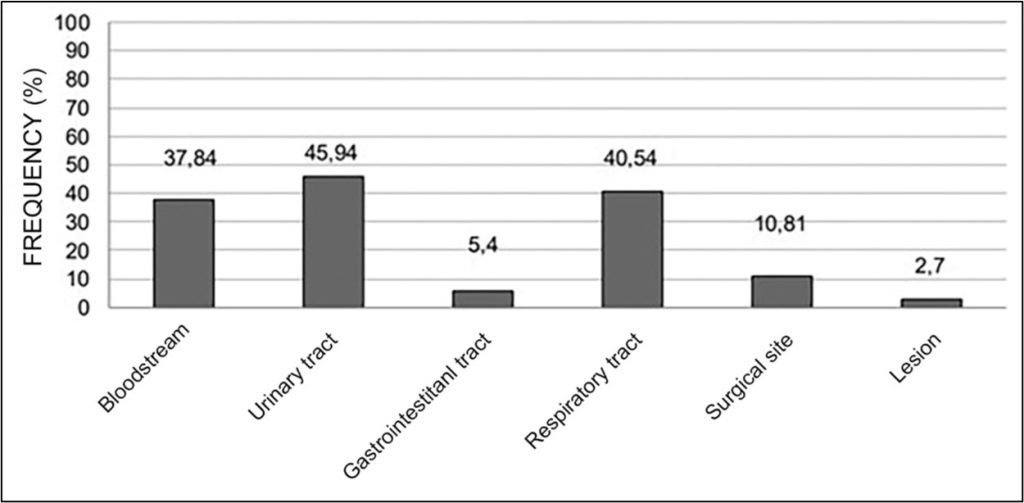
Figure 1
Anatomical distribution of laboratory-confirmed HAIs identified by culture among cases admitted to the ICU, 2022.
Source: Authors, 2025.
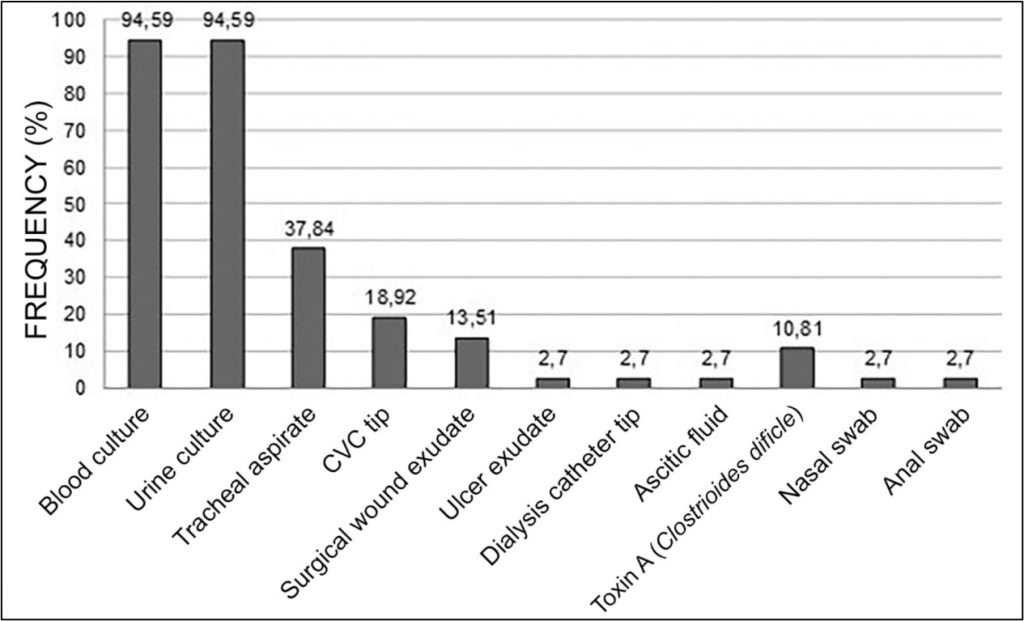
Figure 2
Distribution of the types of cultures and tests performed among HAI cases admitted to the ICU in 2022.
Legend: CVC = central venous catheter.
Source: Authors, 2025.
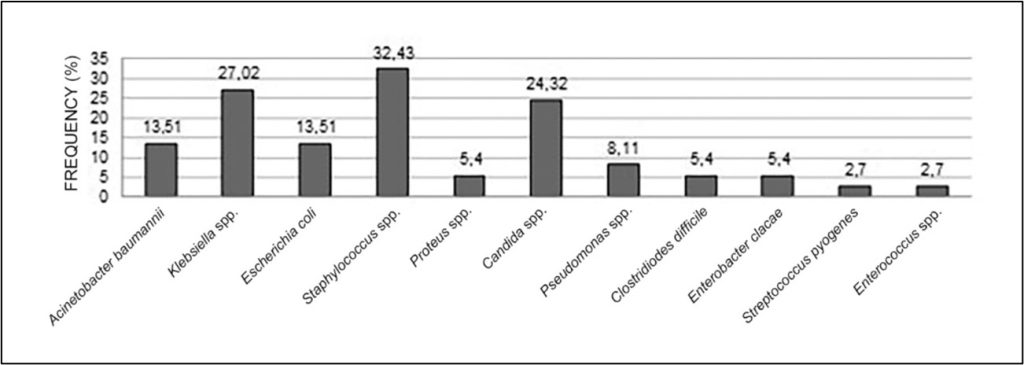
Figure 3
Distribution of microorganisms isolated from HAI cases in 2022.
Source: Authors, 2025.
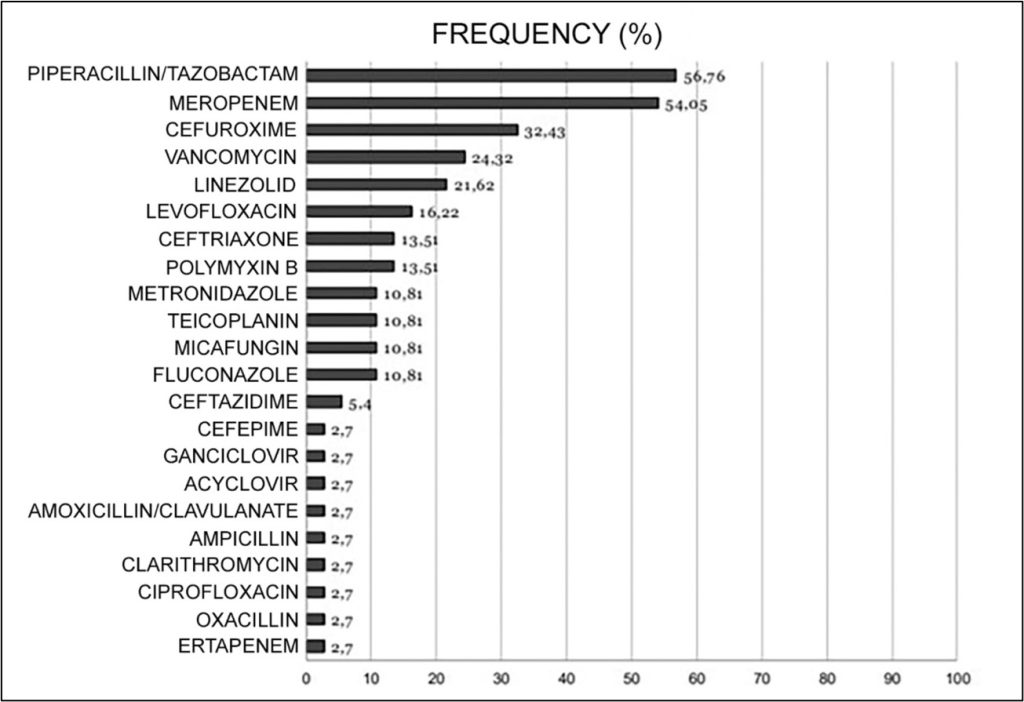
Figure 4
Antimicrobial agents used in patients with HAIs in 2022.
Source: Authors, 2025.
DISCUSSION
Patients admitted to intensive care units (ICUs) are at substantial risk of acquiring healthcare-associated infections (HAIs) because of the high frequency of procedures, the need for venous access and invasive devices, immunosuppression, comorbidities, frailty, and advanced age. Despite existing preventive measures, HAIs remain a significant cause of morbidity and mortality worldwide.(15,16)
In this study, the HAI prevalence was 4.29%, which differs from the 10%–41% prevalence reported in other studies.(8,10-13) This difference may be partly related to hospital size and local epidemiology, as the study was conducted at a medium-sized hospital in an inland municipality. The other studies analyzed were conducted in state capitals or large metropolitan areas, where patient volumes and hospital admissions are higher.(17,18)
The main risk factors associated with HAIs are related to diagnostic and therapeutic interventions. The most common include the use of invasive devices, such as urinary catheters and venous catheters; prolonged use of airway devices, including endotracheal intubation, tracheostomy, and mechanical ventilation; chronic diseases and comorbidities; traumatic injuries; and length of hospital stay.(19,20) Studies also suggest that female sex and advanced age are well-established risk factors for HAIs.(21) In this study, because of the small sample size, no statistically significant associations were identified for a length of stay of 6 days or more, use of invasive devices, or the presence of comorbidities; however, a higher number of deaths was observed among individuals in these categories.
The most frequent infections were urinary tract infections, followed by respiratory tract and bloodstream infections. Similar findings have been reported in the literature.(11,18-23) Although the ranking of these infections varies among the studies cited, these remain among the most frequently reported infection sites.
Traumatized areas are conducive to bacterial proliferation because of the presence of blood within hematomas and devitalized tissue. In addition, complications resulting from previous surgical procedures represent another important factor. Surgical procedures performed in emergency situations, in debilitated patients, or in patients with preexisting infections are often associated with a higher risk of infectious complications.(18) Despite this, a low prevalence of lesion-related infections and surgical site infections was observed.
The main pathogens isolated in this study were Staphylococcus spp., Klebsiella spp., and Candida spp., including resistant pathogens such as methicillin-resistant S. aureus (MRSA), ESBL-producing K. pneumoniae, and carbapenemase-producing K. pneumoniae. Less frequently isolated pathogens included A. baumannii, Escherichia coli, Pseudomonas spp., Proteus spp., C. difficile, E. cloacae, S. pyogenes, and Enterococcus spp. These findings are consistent with those reported in the literature. Currently, carbapenemase-producing K. pneumoniae strains, particularly KPC-producing strains, are widespread in several countries, including Israel, Greece, Italy, Poland, China, Brazil, Argentina, and Colombia, and are becoming increasingly common throughout Europe.(11,12,16) Candida auris has also emerged as a pathogen of concern, affecting regions such as India and the Middle East and causing outbreaks in several parts of the world, including the United States, Europe, and Asia. Other frequently isolated microorganisms include P. aeruginosa, A. baumannii, and E. coli.(11,12,16,24,25)
Because of the presence of multiple risk factors, patients admitted to ICUs are at increased risk of C. difficile infection. C. difficile infection occurs when the normal intestinal microbiome becomes disrupted. In this setting, the microorganism proliferates uncontrollably, overcomes the host’s immune defenses, and produces toxins A and B. These toxins cause alterations in colonic epithelial cells, resulting in symptoms such as diarrhea, paralytic ileus, and even colonic perforation.(19,26) Gastrointestinal tract infections are not included in the Brazilian Ministry of Health’s National List of Notifiable Diseases, Conditions, and Public Health Events and are therefore not subject to mandatory notification. Nevertheless, the confirmation of HAI cases caused by C. difficile in the present study is noteworthy.
Regarding antimicrobial therapy, the main classes used were penicillins, carbapenems, second-generation cephalosporins, glycopeptides, and oxazolidinones, represented by piperacillin/tazobactam, meropenem, cefuroxime, vancomycin, and linezolid, respectively. Few studies in the literature have evaluated the most frequently used antimicrobial agents; however, some studies have shown that the most commonly used antimicrobial classes include combinations of penicillins with beta-lactamase inhibitors, third-generation cephalosporins, particularly ceftriaxone, and fluoroquinolones.(27,28) In the present study, fluoroquinolones and third-generation cephalosporins were also used, although less frequently.
CONCLUSION
Based on the study findings, healthcare-associated infections influence mortality rates in intensive care units, prolong hospital stays, and impose substantial costs on healthcare institutions. These infections are intrinsically associated with several risk factors, including adverse clinical conditions, comorbidities, invasive procedures, and alterations in the microbiota. Although the prevalence of HAIs in this study was comparable to that reported in developed countries, continuous surveillance of the care provided to critically ill patients remains necessary. Therefore, healthcare professionals must strictly adhere to aseptic techniques, perform hand hygiene consistently, and use invasive procedures and antimicrobial agents judiciously in routine patient care. The findings of this study underscore the importance of HAI surveillance for implementing preventive measures, selecting appropriate antibiotic therapy, and reducing infection rates.
ACKNOWLEDGMENTS
We thank the Institutional Scientific Initiation Scholarship Program of the Universidade Federal da Bahia and the Conselho Nacional de Desenvolvimento Científico e Tecnológico (CNPq) for providing undergraduate research scholarships.
REFERENCES
- European Centre for Disease Prevention and Control. Directory of online resources for prevention and control of antimicrobial resistance (AMR) and healthcare-associated infections (HAI) [Internet]. 2017. [cited on Aug 19, 2025]. Available from: https://www.ecdc.europa.eu/en/publications-data/directoryonline-resources-prevention-and-control-antimicrobial-resistance-amr.
- World Health Organization. Development and implementation of national action plans for infection prevention and control: practical guide [Internet]. 2025. [cited on Oct 18, 2025] Available from: https://iris.who.int/server/api/core/bitstreams/978bf650-004c-48f5-a987-2bafdf510dff/content
- Biblioteca Virtual em Saúde. 15/5: Dia nacional do controle das infecções hospitalares [Internet]. Brasília: Ministério da Saúde, 2022. [cited on Oct 18, 2025]. Available from: https://bvsms.saude.gov.br/15-5-dia-nacional-do-controle-das-infeccoeshospitalares-3/.
- Khan HA, Baig FK, Mehboob R. Nosocomial infections: Epidemiology, prevention, control and surveillance. Asian Pac J Trop Biomed. 2017 may; 7(5):478–82. doi: https://doi.org/10.1016/j.apjtb.2017.01.019
- Leal MA, Freitas-Vilela AA. Costs of healthcare-associated infections in intensive care unit. Rev Bras Enferm. 2021;74. doi: http://dx.doi.org/10.1590/0034-7167-2020-0275.
- Healthcare-Associated Infections (HAIs). About HAIs. 2025 [cited on Aug 19, 2025]. Available from: https://www.cdc.gov/healthcare-associatedinfections/about/index.html.
- Lei nº 9.431, de 6 de janeiro de 1997. Dispõe sobre a obrigatoriedade da manutenção de programa de controle de infecções hospitalares pelos hospitais do País. [Internet]. Brasília: 1997. [cited on Oct 18, 2025]. Available from: https://www.planalto.gov.br/ccivil_03/leis/l9431.htm#:~:text=LEI%20N%C2%BA%209.431%2C%20DE%206%20DE%20JANEIRO%20DE%201997.&text=Disp%C3%B5e%20sobre%20a%20obrigatoriedade%20da,hospitalares%20pelos%20hospitais%20do%20Pa%C3%ADs.
- Martins P. Epidemiologia das infecções hospitalares em centro de terapia intensiva de adulto [mestrado]. Belo Horizonte: Faculdade de Medicina, Universidade Federal de Minas Gerais; 2006. [cited on Oct 18, 2025] Available from: https://repositorio.ufmg.br/handle/1843/ECJS-6XWQ8R.
- World Health Organization (WHO s. d.). Infection prevention and control. [cited on Sep 14, 2023]. Available from: https://www.who.int/teams/integrated-healthservices/infection-prevention-control.
- Maoulainine FMR, et al. Épidémiologie de l’infection nosocomiale bactérienne dans un service de réanimation néonatale marocain. Arch Pediatr. 2014;21:938-943. doi: http://dx.doi.org/10.1016/j.arcped.2014.04.033
- Figueiredo DA, Vianna RPT, Nascimento JA. Epidemiologia da infecção hospitalar em uma unidade de terapia intensiva de um hospital público municipal de João Pessoa-PB. Revista Brasileira de Ciências da Saúde. 2013;17:233-240. doi: http://dx.doi.org/10.4034/rbcs.2013.17.03.04
- Oliveira AC, Kovner CT, Silva RS. Nosocomial infection in an intensive care unit in a brazilian university hospital. Rev Latino-Am Enfermagem. 2010;18(2):233-239. doi: http://dx.doi.org/10.1590/s0104-11692010000200014
- Gusmão MEN. Infecção hospitalar: mortalidade, sobrevida e fatores prognósticos no Hospital Universitário Professor Edgard Santos/UFBA [doutorado]. Salvador: Instituto de Saúde Coletiva, Universidade Federal da Bahia. 2008. [cited on Aug 19, 2025]. Available from: https://repositorio.ufba.br/bitstream/ri/11567/1/Tese%20Enoy%20Gusm%C3%A3o.%202013.pdf
- World Health Organization (WHO s. d.). Infection prevention and control. [cited on Sep 14, 2023]. Available from: https://www.who.int/teams/integrated-healthservices/infection-prevention-control
- Blot S, et al. Healthcare-associated infections in adult intensive care unit patients: changes in epidemiology, diagnosis, prevention and contributions of new technologies. Intensive Crit Care Nurs. 2022;70. doi: http://dx.doi.org/10.1016/j.iccn.2022.103227
- Kelly D, Kutney-Lee A, Lake ET, Aiken LH. The critical care work environment and nurse-reported health care-associated infections. Am J Crit Care. 2013;22:482-488. doi: http://dx.doi.org/10.4037/ajcc2013298
- Braga IA, Campos PA, Bastião DWF, Gontijo Filho PP, Ribas RM. Using point prevalence survey to define burden of antimicrobial use among 35 adult intensive care units in Brazil. Infect Dis. 2019;51;459-462. doi: http://dx.doi.org/10.1080/23744235.2019.1581371
- Sossai LM, Almeida CL. Infecção hospitalar na unidade de terapia intensiva: fatores de risco e mortalidade. Revista Gestão & Saúde. 2011;(6):25-33. [cited on Aug 19, 2025]. Available from: https://www.herrero.com.br/site/files/revista/file463bf8426dbd4406a937d5238 3c7cefd.pdf
- Mazzeffi M, Galvagno S, Rock C. Prevention of healthcare-associated infections in intensive care unit patients. Anesthesiology. 2021;135:1122- 1131. doi: http://dx.doi.org/10.1097/aln.0000000000004017
- Firoozeh N, Agah E, Bauer ZA, Olusanya A, Seifi A. Catheter-associated urinary tract infection in neurological intensive care units: a narrative review. Neurohospitalist. 2022;12(3):484 – 497. doi: https://doi.org/10.1177/19418744221075888
- Vincent JL, et al. International study of the prevalence and outcomes of infection in intensive care units. JAMA. 2009. doi: http://dx.doi.org/10.1001/jama.2009.1754
- Vogelaers D, et al. Patterns of antimicrobial therapy in severe nosocomial infections: empiric choices, proportion of appropriate therapy, and adaptation rates-a multicentre, observational survey in critically ill patients. Int J Antimicrob Agents. 2010;35:375-381. doi: http://dx.doi.org/10.1016/j.ijantimicag.2009.11.015
- Singh CS, Chaturvedi ACR, Garg BSM, Datta CR, Kumar MA. Incidence of healthcare associated infection in the surgical ICU of a tertiary care hospital. Med J Armed Forces India. 2013;69:124-129. doi: http://dx.doi.org/10.1016/j.mjafi.2012.08.028
- Albiger B, Glasner C, Struelens MJ, Grundmann H, Mmonnet DL. Carbapenemase-producing Enterobacteriaceae in Europe: assessment by national experts from 38 countries, may 2015. Euro Surveill. 2015;20. doi: http://dx.doi.org/10.2807/1560-7917.es.2015.20.45.30062
- Agarwal R, Gupta D, Ray P, Aggarwal AN, Jindal SK. Epidemiology, risk factors and outcome of nosocomial infections in a respiratory intensive care unit in North India. J Infect. 2006;53(2):98-105. doi: http://dx.doi.org/10.1016/j.jinf.2005.10.021
- Karanika S, Paudel S, Zervou FN, Grigoras C, Zacharioudakis IM, Mylonakis E. Prevalence and clinical outcomes of Clostridium difficile infection in the intensive care unit: a systematic review and meta-analysis. Open Forum Infect Dis. 2015;3. doi: http://dx.doi.org/10.1093/ofid/ofv186
- Antonioli P, et al. A 2-year point-prevalence surveillance of health care associated infections and antimicrobial use in Ferrara University Hospital, Italy. BMC Infect Dis. 2020;20. doi: http://dx.doi.org/10.1186/s12879-020-4791-8
- Matar MA, et al. Point prevalence survey of antibiotic use in 26 Saudi hospitals in 2016. J Infect Public Health. 2019;12:77-82. doi: http://dx.doi.org/10.1016/j.jiph.2018.09.003
Correspondence
Milena Soares dos Santos
E-mail: [email protected]